Radisson RED
Heathrow.
Every screen in the building, working as one. What is possible in each position, and how it all fits together.

Every screen in the building, working as one. What is possible in each position, and how it all fits together.

A joint view from TrouDigital and PixelGlo of what is possible at Radisson RED Heathrow. The starting point is the estate already in the building: the meeting room tablets and the large screens on the ground floor. From there, the same screens can carry live information, wayfinding and promotion.
None of it has to arrive at once. Each one is a content decision later, not a new system.
We work together to deliver first class digital signage projects, bringing the right mix of software, hardware and delivery to each site.
Not a fixed scope or a priced install. It sets out the options available across the hotel, how each position would work, and what the platform can do. Where the hotel starts, and in what order, is something to work through together once the priorities are clear.

TrouDigital and PixelGlo set out the digital signage options for Radisson RED Heathrow: commercial displays, meeting room tablets, media players, the TrouDigital cloud CMS, remote device management, warranty administration and support. The hotel team runs the content day to day.
The service is designed to run brand campaigns, food and drink promotion, meeting and event information, live flight times, hotel services, wayfinding and emergency notices across the hotel, starting with the screens and tablets already installed.
Hardware is purchased outright. Software and support run on a subscription, so the hotel can publish once to the whole building while each zone keeps its own local message.

A single browser-based CMS run by the Radisson RED team, covering everything from a brand film on the reception wall down to the schedule on one meeting room tablet. No software to install, no local servers, and no need to call IT to publish something.
The hotel builds from locked Radisson templates, or uploads finished artwork from Canva, Adobe or its own designer. Built-in apps cover weather, date and time, social feeds, RSS, web pages and countdowns.
Dayparting switches between breakfast, check-out, afternoon, evening bar and overnight messaging on its own. Event and conference boards can be set weeks ahead and expire when the event ends.
Screens are grouped by zone and by type. One publish can hit every screen in the building, the meeting floor tablets only, the bar, or a single screen in a lift lobby, without rebuilding the content each time.
Permissions map to the account structure, so a department can be given edit rights to its own zone only, with optional approval before anything publishes. SSO is available on the Enterprise Dedicated Instance to keep login aligned with Radisson directory services.
Location and zone, manufacturer and model, display size, serial numbers, media player details and ID, install and warranty dates, mounting type, network method, online status and support history.
Flight times, transfer departures, meeting room bookings, group arrivals and weather can be pulled from a feed, spreadsheet or an existing system, so screens change without anyone editing artwork.

Everything sits in one central account for the hotel, and from there the screens can be split into groups by department, by the team that owns them, or by area. Hierarchy and permissions decide who can publish where, so one person can run the whole estate or each team can look after its own screens.
Unlimited users, each with their own login, so publishing is never shared through one password.
Full admin, edit within one group of screens, or upload only, set per user.
Content can be held for approval before it reaches a screen where that is wanted.
A record of who published what and when, and what is scheduled next.
The hotel team produces the artwork (Canva, Adobe, standard image and video assets), uploads it once, and schedules it to any set of screens: the whole hotel, one zone, the meeting floor tablets, or a single screen behind reception.

A range covering every position in the hotel, from a tablet outside a meeting room to a video wall behind reception. All main displays are commercial build with portrait and landscape capability, 3-year manufacturer warranty, all-day operation, scheduled power and remote management.

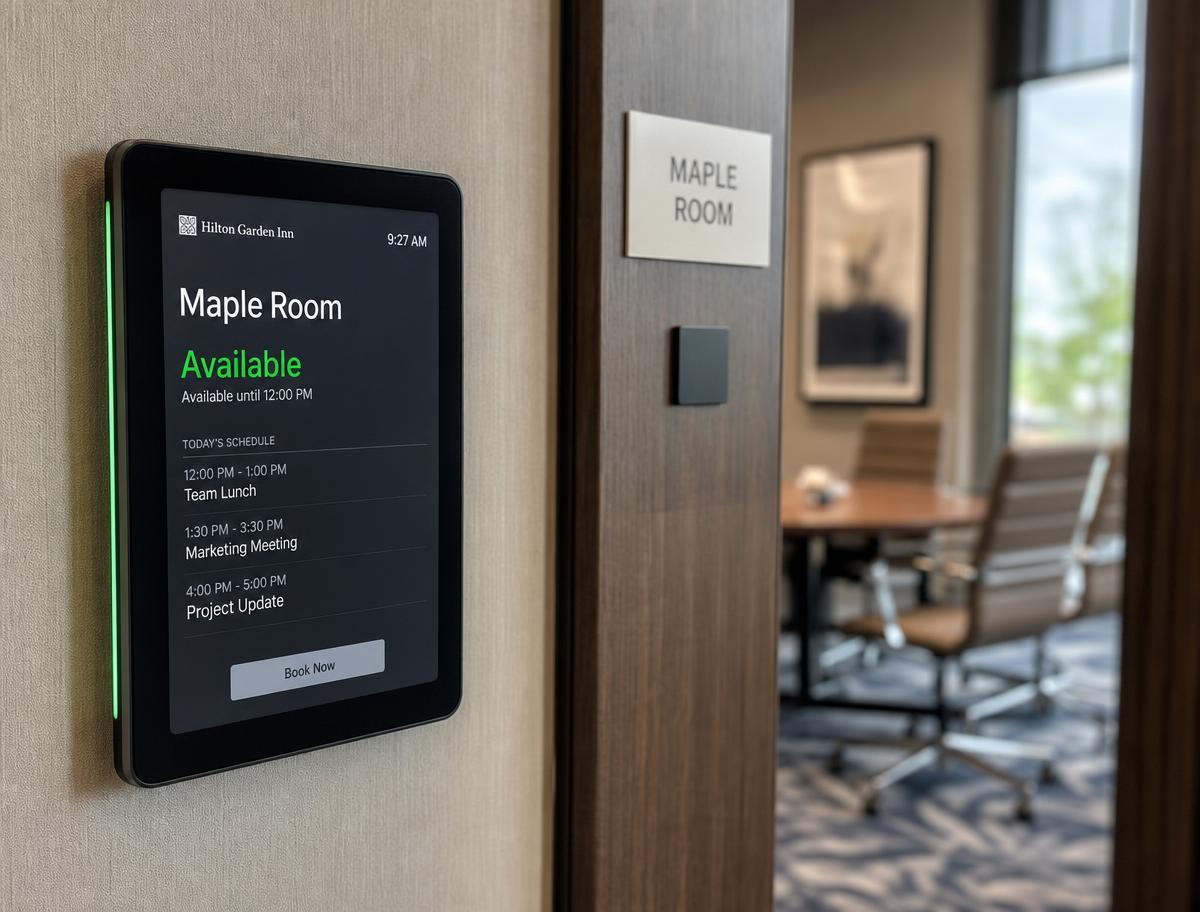
Small wall-mounted touch tablet beside the door, PoE or mains powered.
Use: Room name, today's schedule, availability and on-the-spot booking outside each meeting room.


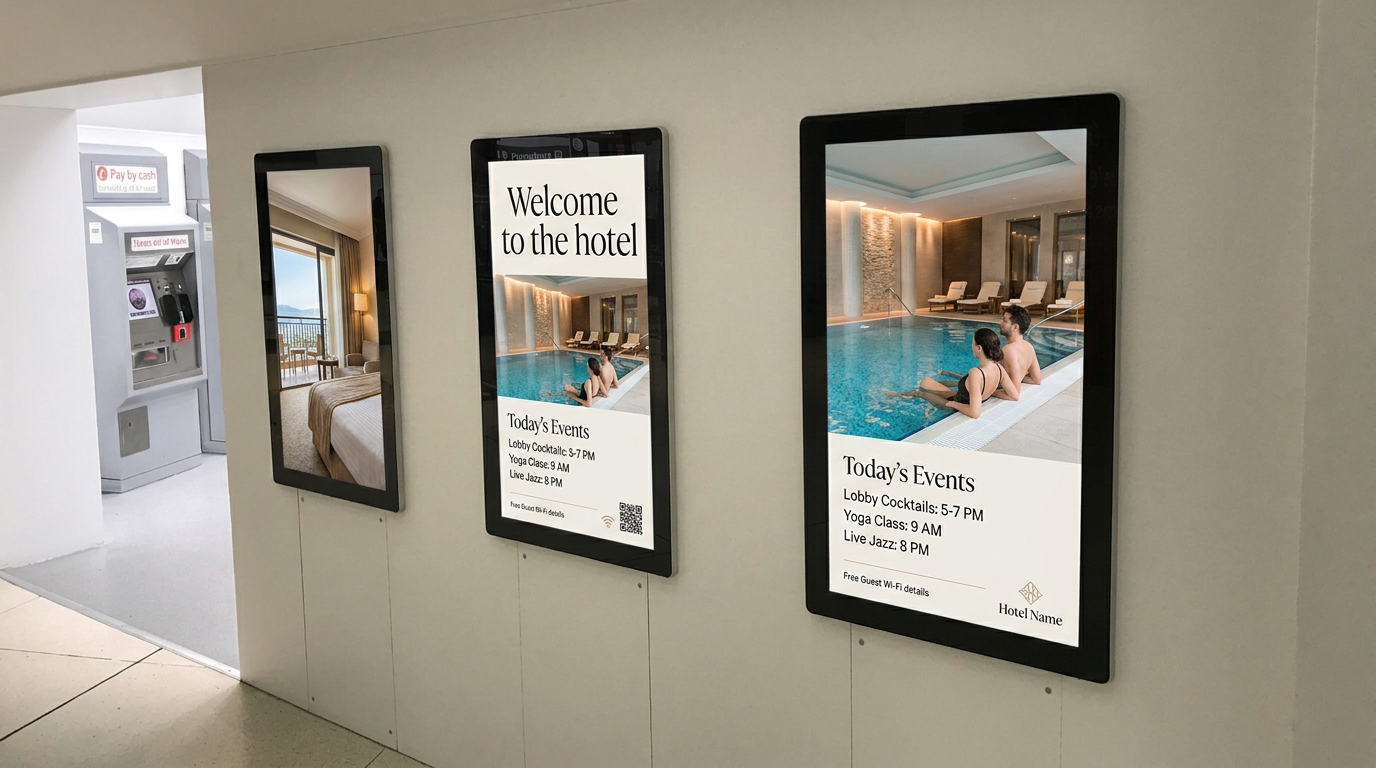
Commercial display in a range of sizes, landscape or portrait, wall or ceiling mounted with an external media player.
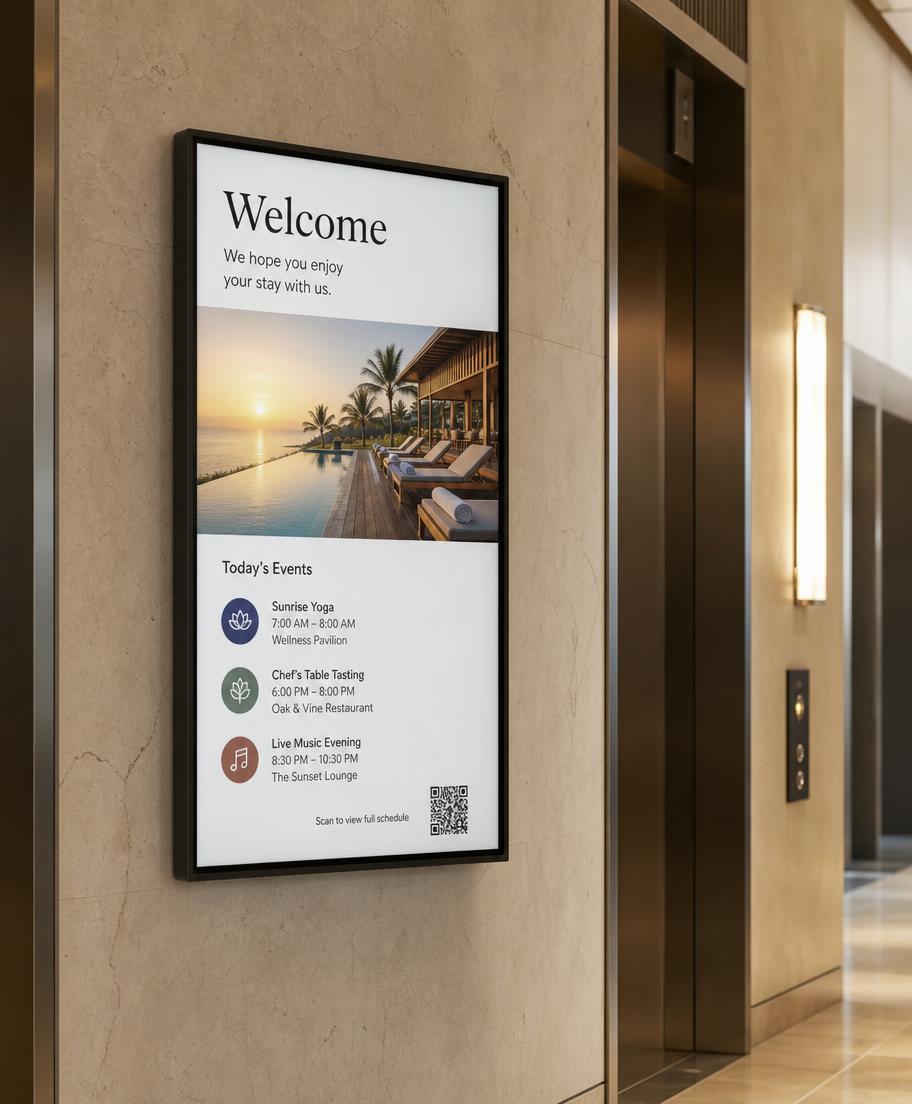
Use: The workhorse position. Lift lobbies, corridors, lobby, restaurant and meeting floor.

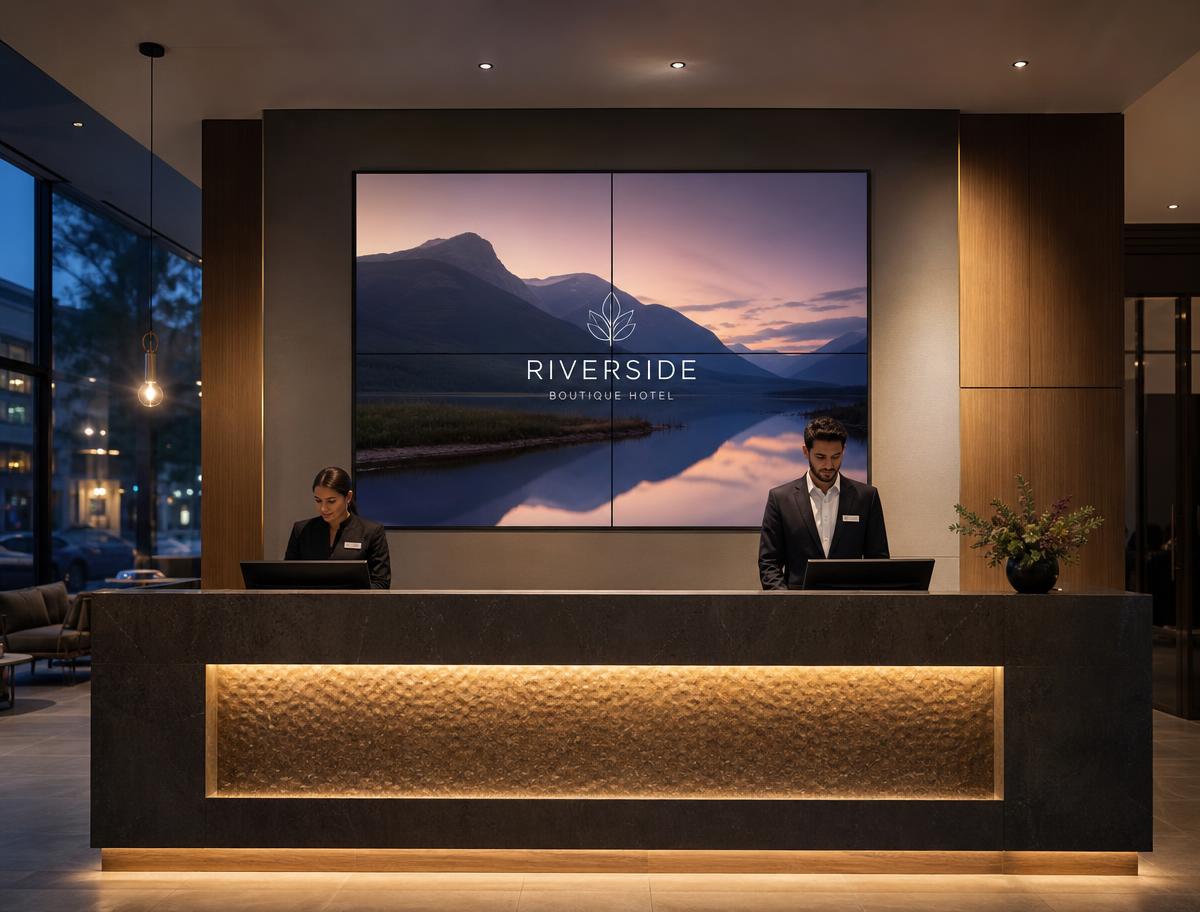
Multiple narrow-bezel screens aligned as one canvas, scaled to as many panels as the wall allows, or a single fine-pitch LED surface.
Use: Behind the reception desk. Brand film, welcome messaging and live information on one feature wall.

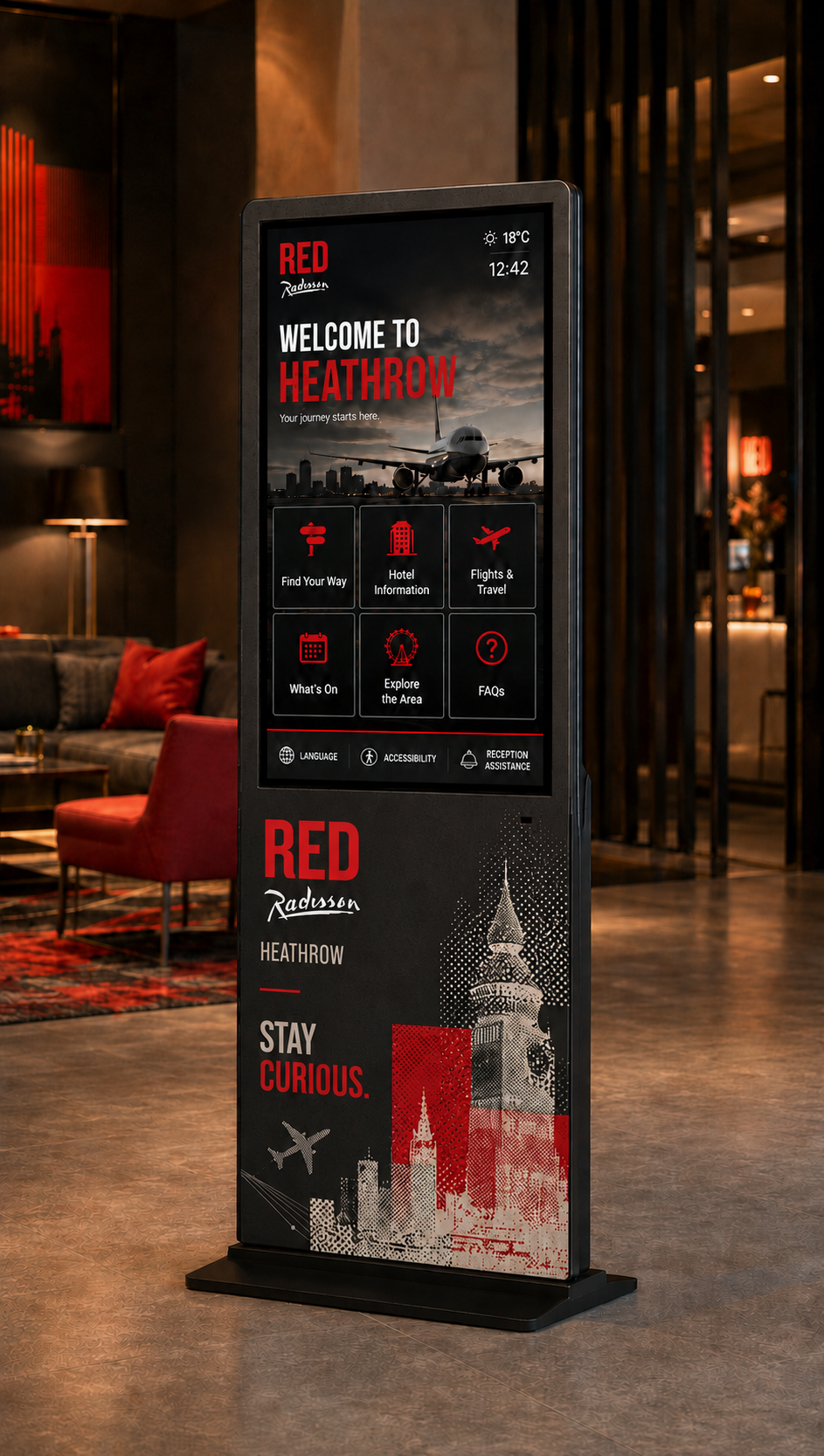
Portrait totem or landscape kiosk, touch optional, no wall fixings required.
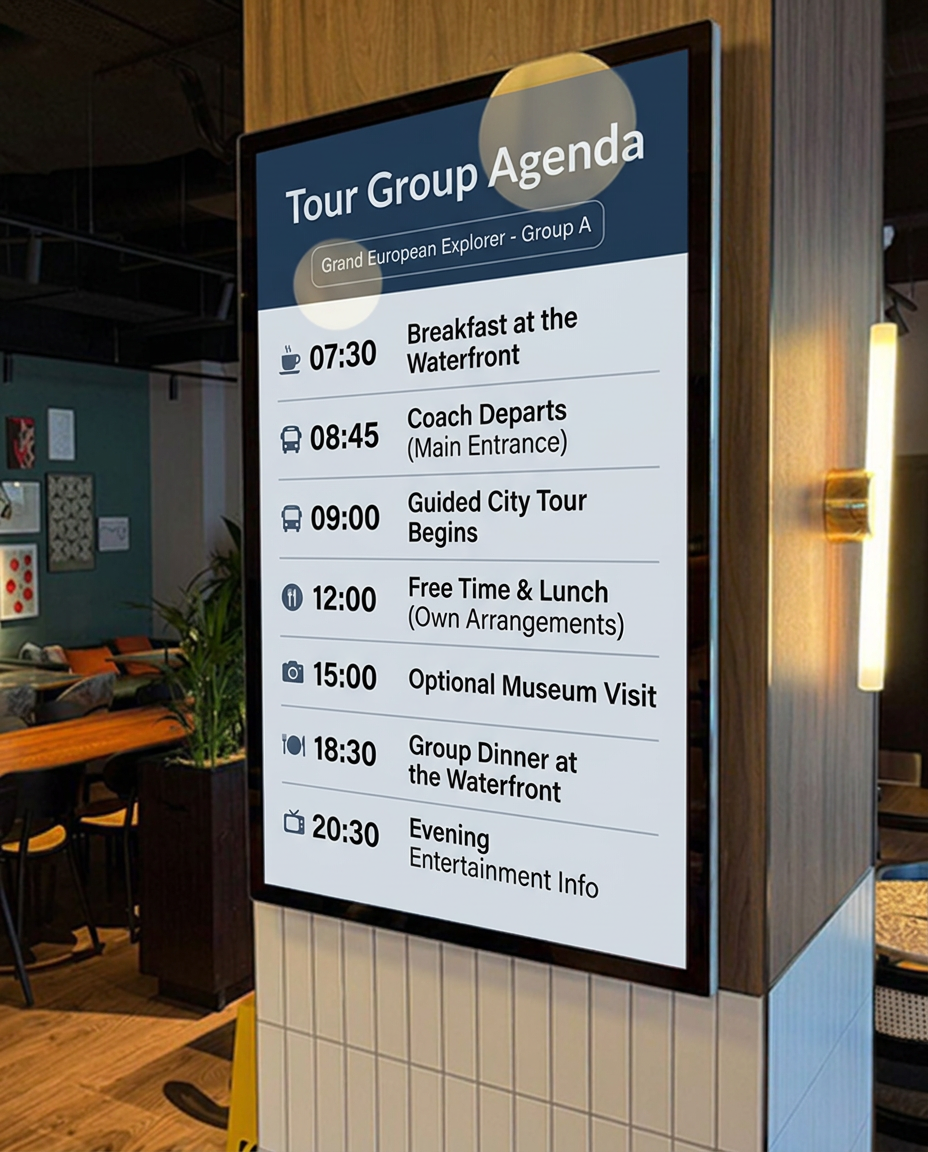
Use: Lobby and entrance. Wayfinding, hotel information and tour group boards where no wall is available.

Toughened glass, high brightness, secure mounting with concealed cable and player.
Use: Porte-cochère, coach drop-off and window positions with daylight and public traffic.

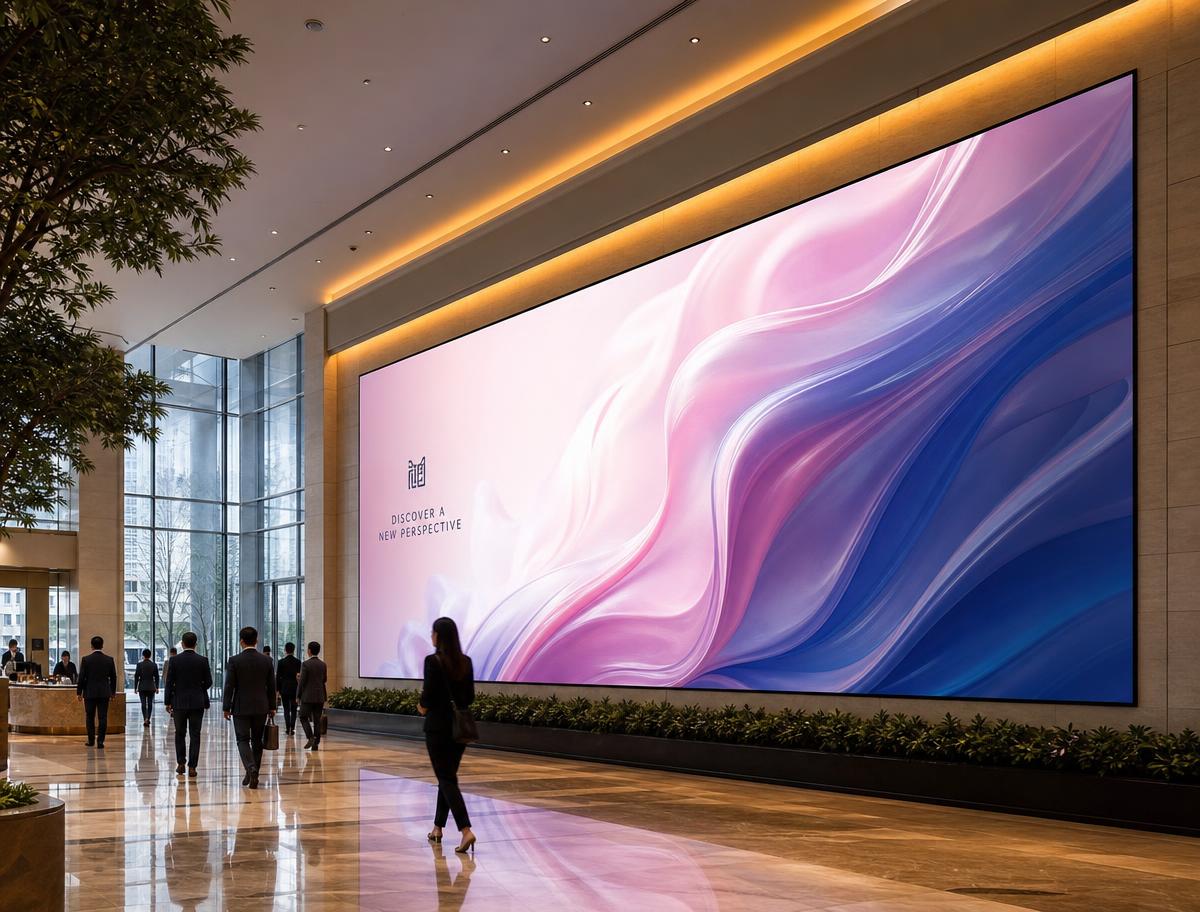
Fine-pitch indoor LED built to any size, seamless single canvas, bright enough for a glazed lobby.
Use: Statement wall in the lobby or event space, sized to the architecture rather than to a screen bezel.
Final mix of tablets, wall screens, the reception video wall, totems, kiosks and toughened units is agreed position by position during a site walk with PixelGlo. Pricing is confirmed once quantities and mounting are known.

Being the Radisson RED next to Heathrow, with direct terminal transfers, changes what the screens should be doing. A large part of the lobby at any moment is either heading to a flight or has just come off one. Live information earns its place on the wall and takes pressure off the front desk, alongside the everyday hotel information guests ask for.
Illustrative. Departure data comes from a flight information feed, shown full screen on a totem or as a strip alongside brand content on a wall screen or the reception video wall.
Next transfer times, pick-up point and journey time by terminal, sitting next to the departures list. Guests stop asking reception the same question, and late arrivals can see the next service without waiting in line.
The same screens carry the day-to-day information guests ask reception for, updated once and shown wherever it is useful. Group arrivals and coach calls can be added as another board when they are needed.
A touch totem or kiosk in the lobby answers the questions that reach the desk all day, in the guest's own language, at any hour.

Once every screen in the building runs on one platform, it becomes a safety channel as well as a guest channel. One button takes over every display at once and puts the same instruction in front of everyone in the hotel, then hands the screens back when it is cleared.
Every screen switches to evacuation instructions and the assembly point, in the languages the hotel needs.
A single instruction across the building, replacing all commercial content instantly.
A pre-built notice on the affected floors only, so guests are informed without a hotel-wide alarm.
One action returns every screen to its normal schedule, with the resumption logged.
We built a web based emergency communication system for Strand Palace, letting authorised staff broadcast an urgent message across every connected screen with one click. Scheduled content is overridden by visual and audible alerts telling guests to stay in their rooms, avoid an area or follow other instructions, and staff can issue live updates as the situation develops. Once resolved, screens return to their normal schedules, turning an existing signage network into a central emergency channel.
This does not replace the fire alarm, the voice alarm or the hotel's evacuation procedure. It sits alongside them, adding a visual instruction on every screen for guests who may not speak English, may not hear an announcement, or are standing in a busy lobby with luggage.

Illustrative view only. Live reporting is set up against the agreed zone structure during onboarding.
Hardware, connectivity and platform faults are triaged by TrouDigital rather than landing on the duty manager, with remote device access, fault diagnosis, replacement coordination, training and account reviews.


Touch is part of the standard CMS. Creatives are linked together so a guest moves between pages on the screen, with no separate development work. A touch wayfinding kiosk is built and scheduled the same way as any other screen.
Screens in back of house and staff areas carry internal communications. Hotel-wide messages sit in one layer, with each department able to post its own notices to its own staff screens.
Totems and touch screens in the lobby and lift lobbies direct guests and delegates to rooms, outlets and transfers, and switch to event-specific directions when a conference is in the building.
Not part of the first deployment, but worth keeping a route open to. Bespoke web and API-based experiences can be built later if Radisson RED wants to push the estate further.
Portable screens on wheeled stands can be moved into the event space for a conference, cache their content in advance and play video without relying on guest Wi-Fi. Useful for delegate welcome boards, sponsor branding and sales show-rounds.

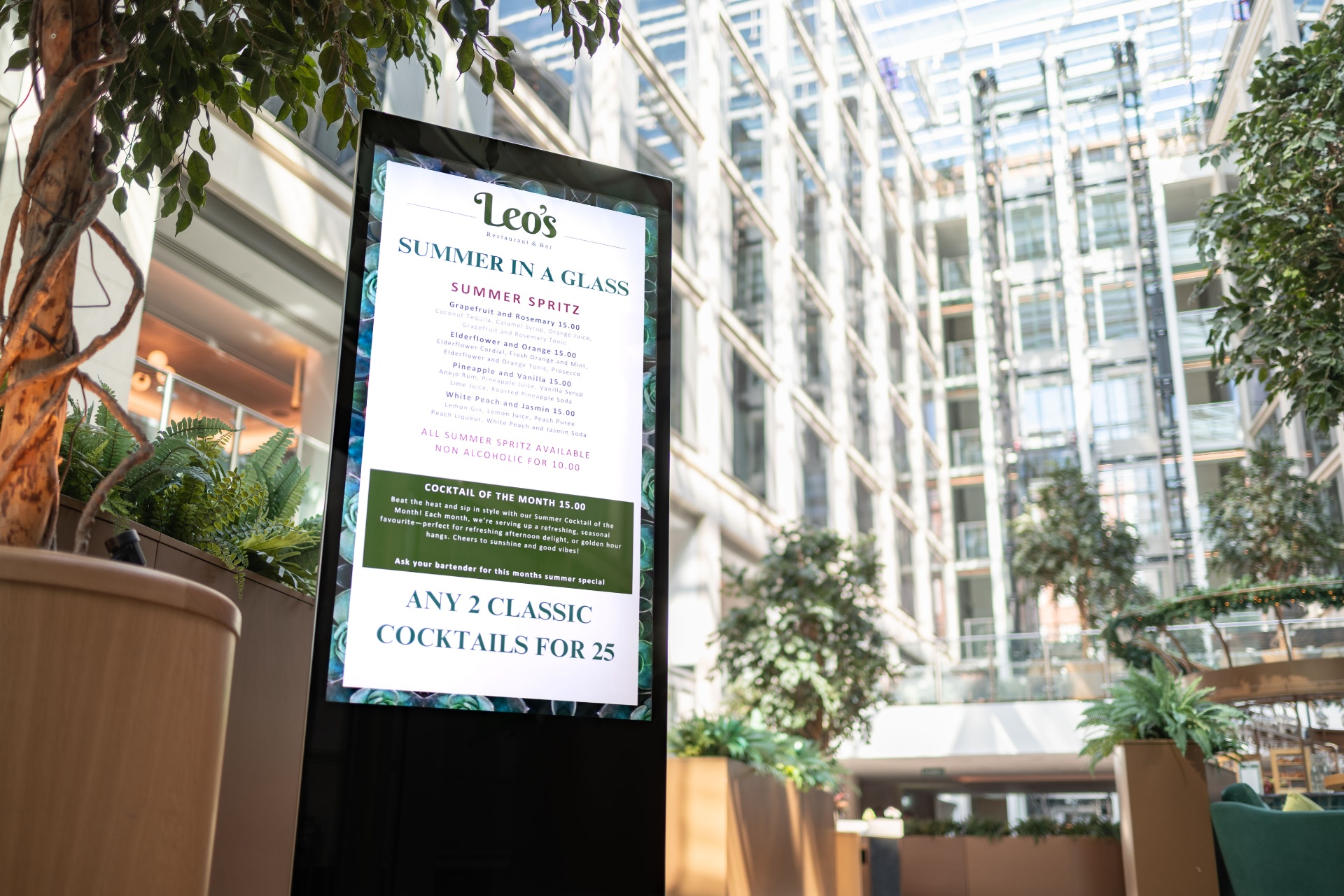
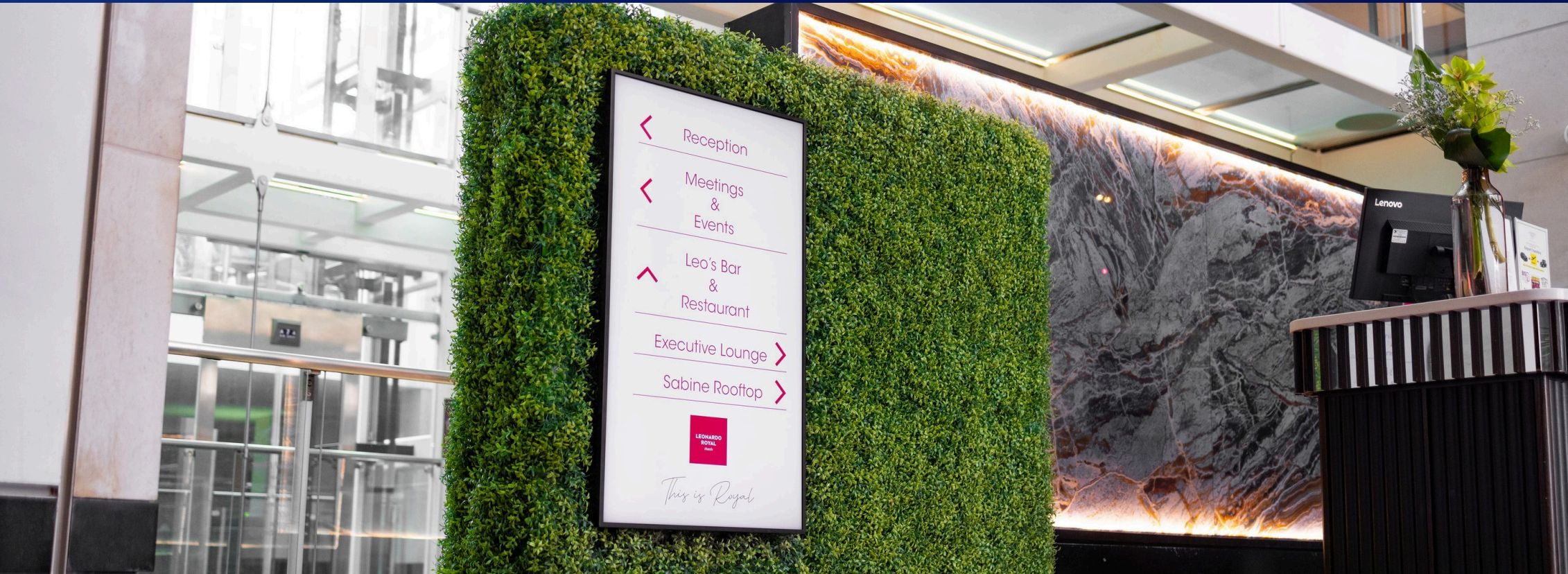
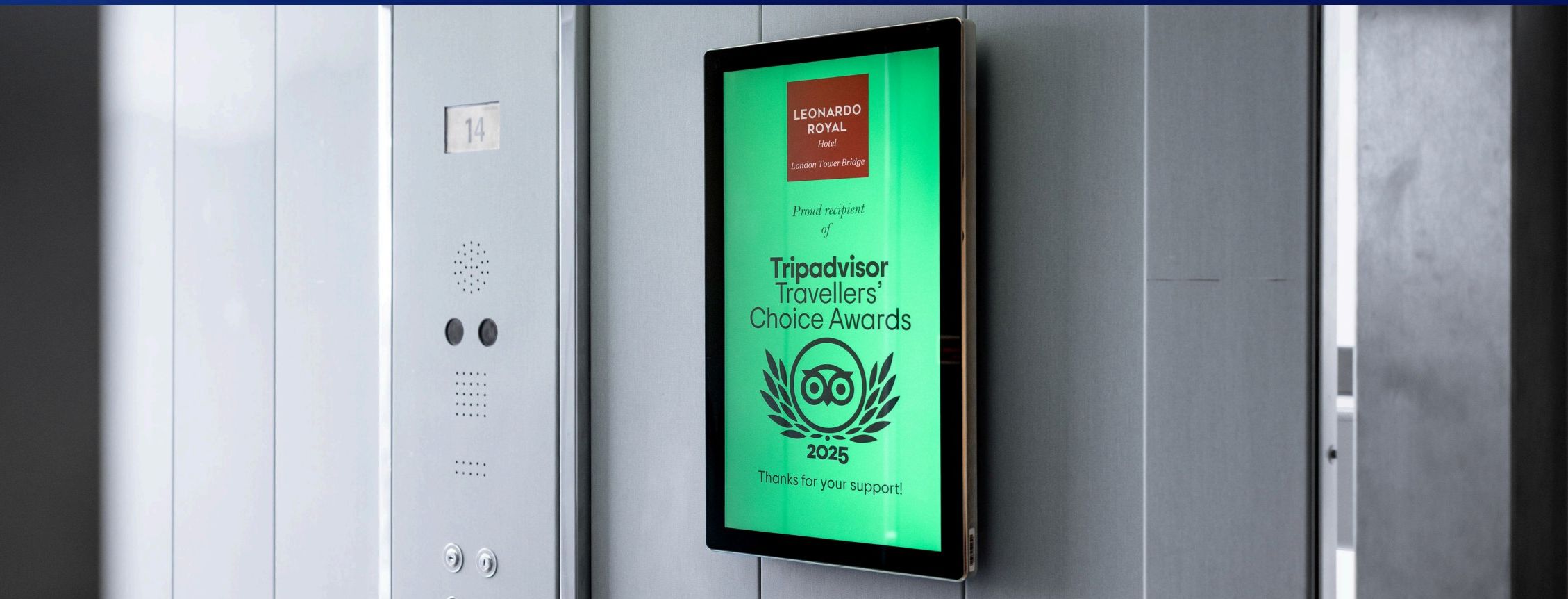
TrouDigital works with Leonardo Hotels across seven sites, including these three Leonardo Royal properties in London. Same platform, same support desk, three very different jobs: conference and event communication, guest wayfinding and dining promotion, and lift lobby messaging floor by floor. Each hotel team publishes its own content.

“We use TrouDigital's screens throughout our event and conference spaces to welcome guests, promote events and display meeting agendas. It is simple to use and reliable.”Umesh, Leonardo Royal London City

“We use our digital signage screens to share key messages and communicate with our guests. The system is easy to manage and has helped us deliver timely, engaging content across the hotel.”Vishant, Leonardo Royal St Paul's

“The displays are a fantastic way to share hotel updates, celebrate achievements and showcase awards to guests as they move around the building. Seamless from installation through to ongoing support.”Leonardo Royal Tower Bridge

The hotel adds a TrouDigital account to the existing signage platform. Read access is enough.
Every asset, playlist and schedule currently running is exported by our team, not yours.
Content is loaded into the new account, screens grouped by area, schedules recreated as they run today.
We switch the screens over out of hours. Nothing goes dark, and the team logs in to a familiar setup.
No rebuilding from scratch, no double-keying and no gap in service. Included as part of onboarding.

Built for continuous playback in public spaces. Handles video, live dashboards and flight data day after day.
One required per display screen. More secure and more powerful than running content on the display itself. Not required for tablets.
If SSO is required, the upgrade applies to every active licence in the deployment.

Taking the existing tablets and ground floor screens onto one platform proves the workflow quickly, then the video wall, totems and touch positions follow at the hotel's pace.
A site walk with PixelGlo to audit the existing tablets and ground floor screens, and mark up the positions for the video wall, totems and touch points.
Bring the meeting room tablets and current screens onto the platform, build the first content set, and hand day-to-day publishing to the hotel team.
Install the reception video wall, lobby totems and touch wayfinding, connect the live flight feed, and configure the emergency trigger.